

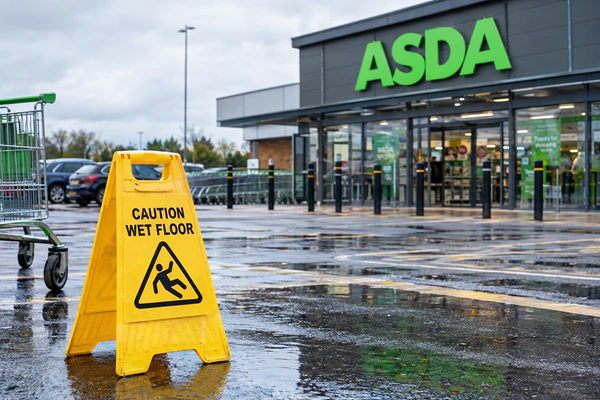
A slip in a supermarket feels trivial for about a second. Then comes the floor, a sharp pain in a wrist or ankle, and the awkward realisation that half the shop is looking at you. For many people in Lancashire, what follows is weeks of recovery, missed shifts and a nagging question about whether the store should have prevented it.
Whether it should have usually comes down to one detail that most people never think to record: how long the hazard had been there before you reached it. This guide explains how claims against Asda for slips, trips and falls are decided, what to do in the first few days and what compensation may look like.
Can you claim for a fall in Asda?
You can, but only where the fall was caused by the store failing in its legal duty. Simply falling on Asda’s premises is not enough. As the occupier, Asda Stores Limited owes shoppers a duty under the Occupiers’ Liability Act 1957 to take reasonable care that they are reasonably safe while using the store. The word “reasonable” matters. A supermarket is not expected to keep a floor spotless every second, but it is expected to run a sensible system for finding and dealing with hazards.
Courts have looked at supermarket spillages this way for decades. In Ward v Tesco Stores (1976), a customer slipped on spilt yoghurt. The store was unable to show it had taken reasonable care to keep the floor safe, and the Court of Appeal found in the customer’s favour. The same reasoning still shapes how these claims are argued, which means the store’s own records tend to matter as much as your account.
The duty applies at every supermarket in the county. We cover the wider picture in our guide to claims against the big-name supermarkets in Lancashire.
The question that decides most claims: How long was the hazard there?
Picture a wet November afternoon at the entrance of an Asda. A customer trails rainwater across the tiles and someone slips thirty seconds later. Asda has a strong argument that it had no realistic chance to act. If the same puddle had been there for twenty-five minutes, in view of the tills, the argument reverses. The hazard is identical, but the outcome is not.
That is why these claims rest on evidence the store holds rather than only what you saw. When we investigate, we look for:
- CCTV covering the spot and the minutes leading up to the fall
- Floor inspection and cleaning logs for that day
- The incident report and accident book entry
- Staffing levels and staff training records
- The store’s risk assessment for floors and entrances
CCTV is the most urgent item. Stores commonly overwrite footage within a matter of weeks, so a request to preserve it needs to go out early.
A warning cone or wet floor sign does not close the matter either. Under the 1957 Act, a warning only helps the occupier where it is enough, in the circumstances, to let a visitor be reasonably safe. A sign that was too small, in the wrong place or put out too late achieves very little.
Where slips, trips and falls happen in Asda stores
Asda trades from sites across the county, including Blackburn, Blackpool, Burnley, Chorley, Darwen, Fleetwood, Lancaster, Leyland, Morecambe, Preston and Skelmersdale. The layout varies with store size, but the causes repeat. If your fall was in the Preston area, our page on slips in Preston shops covers the local picture.
- Entrances and doorways: Rain carried in on shoes and trolleys makes tiles slick, particularly where matting has bunched up or is already saturated. Lancashire weather makes this a recurring cause for much of the year.
- Chilled, frozen and fresh produce areas: Leaking freezer units, melted ice, dropped fruit and loose salad leaves.
- Checkouts and self-service areas: Spilt drinks, dropped bags and stray packaging.
- Restocking: Cages, pallets and cardboard left in aisles during busy periods. These cause trips more often than slips.
- Changes in floor level: Ramps, thresholds, lifting flooring and poor lighting that hides a step.
- Car parks and forecourts: Ice, potholes, damaged trolley bays and diesel spills. The occupier’s duty extends here, but where a site is shared or leased, responsibility for the car park can sit with a different party. A solicitor should check that early.
Injuries caused by products, food or the petrol station follow different rules and are covered in our guide to claiming compensation after an accident at Asda.
What to do after a fall in Asda
- Get medical attention: Go to A&E, an urgent treatment centre or your GP. Ligament damage and hairline fractures can be missed at first, and medical records are what link the injury to the fall.
- Report it before you leave, if you can: Tell the duty manager, ask for the incident to be recorded and ask for a reference number or a copy. If you were taken away or unable to report it that day, do it as soon as you are able.
- Record the scene: Photograph the hazard, the surrounding floor, any signs, the lighting and your footwear. Note the time, the aisle and the store. If you cannot do it yourself, ask someone with you.
- Collect witness details: Take names and numbers from other shoppers, and note the names of any staff who attended.
- Keep the shoes and clothing you were wearing: Do not wash or throw them away.
- Do not sign anything, or accept money or vouchers as settlement, until you have taken legal advice.
- Keep a running record: Note your symptoms, time off work, receipts, prescriptions and travel to appointments.
Our guide to supermarket injury claim evidence goes further into what carries weight.
How much compensation could you receive?
Compensation has two parts. General damages cover the injury itself: pain, loss of movement and the effect on daily life. Special damages cover money lost or spent because of it, including lost earnings, physiotherapy, prescriptions, travel and help given by family. Future losses count as well where recovery is incomplete.
Solicitors and courts value general damages using the Judicial College Guidelines. The 18th edition, published in April 2026, puts a moderate ankle injury at roughly £18,150 to £35,130. A sprain that clears within weeks falls in a far lower bracket, while an injury leaving lasting disability sits higher. The guidelines are not binding, and two people with the same fracture can receive different awards once age, occupation, recovery and financial loss are taken into account. Nobody can give you a reliable figure before seeing your medical evidence, so treat online calculators with caution.
What if Asda says it was partly your fault?
Expect this argument. Under the Law Reform (Contributory Negligence) Act 1945, compensation can be reduced where an injured person failed to take reasonable care for their own safety, for example by ignoring a visible spill, running or looking at a phone. The reduction is a percentage and does not end the claim. On £10,000 of damages, a 20 per cent reduction leaves £8,000. Footwear is another common target, which is why the shoes you were wearing are worth keeping.
Time limits and who can claim
Most people have three years from the date of the fall to start a claim, under the Limitation Act 1980. For a child, the three years begin on their 18th birthday, although a parent or guardian can bring the claim sooner on their behalf. Where an injury has left someone without the mental capacity to manage a claim, the clock does not start until capacity returns. Evidence and memories fade long before any deadline, so the practical time limit is much shorter than three years.
If you were working in the store when you fell, the claim is different. It is brought against your employer under separate rules, and our page on accident at work claims explains how.
How an Asda claim progresses
Most Asda slip claims are valued below £25,000 and run through the online claims portal under the Pre-Action Protocol for Low Value Personal Injury (Employers’ Liability and Public Liability) Claims. Once the claim is submitted, Asda has 40 business days to respond on liability.
If Asda accepts responsibility, the case moves on to medical evidence and settlement negotiations. If it denies liability or alleges you were partly at fault, the claim leaves the portal and follows the standard protocol. That takes longer and can end in court proceedings if talks fail, although most cases settle beforehand.
A straightforward, admitted claim can conclude within months. We do not settle until your medical prognosis is clear, so a fracture claim usually takes longer.
Speaking to a solicitor in Lancashire
Marley Solicitors handles slip, trip and fall claims across Lancashire from our office at 287 Station Road, Bamber Bridge, Preston. Where a claim is suitable, we can often act on a no win no fee basis. Any success fee comes out of your compensation and is capped by law at 25 per cent of the damages for pain and suffering and past financial losses. A no win no fee agreement must be in writing, so you can read the terms before you sign.
If you have fallen in an Asda store, call 01772 282600 for a free, no-obligation conversation about what happened.